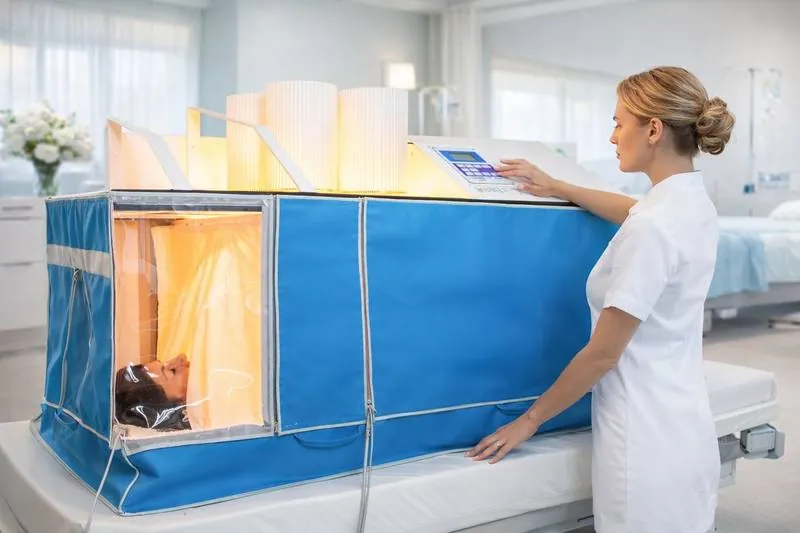
Heat has been used medicinally for thousands of years — from the therapeutic baths of ancient Rome to the fever chambers of early modern medicine. The underlying biological principle has always been sound: many pathogens are significantly more vulnerable to elevated temperature than human tissue is. The challenge has always been achieving and sustaining therapeutic temperatures safely.
Heckel whole-body hyperthermia addresses that challenge. Built by Heckel Medizintechnik, a German manufacturer that has specialized in whole-body hyperthermia systems since 1994, it raises core body temperature into a controlled, fever-like state — temperature-monitored throughout, with intensity and duration adjusted to the individual patient. The result is a whole-body thermal environment that research suggests heat-sensitive Lyme pathogens tolerate poorly.
Human cells evolved with a highly regulated thermal range. The processes that govern protein folding, enzyme function, and cellular repair are calibrated for a core temperature between 36.5°C and 37.5°C — and have a meaningful but limited tolerance for elevation above that range.
Borrelia burgdorferi, by contrast, is a spirochete that originated in tick vectors — organisms that experience wide temperature variation and whose internal environments are far less thermally stable than the mammalian body. Research has shown that Borrelia's structural proteins, membrane components, and enzymatic processes are substantially more sensitive to elevated temperature than human cellular systems.
At elevated, fever-range temperatures, research suggests Borrelia can experience thermal stress that disrupts its protein architecture, impairs its motility, compromises its outer membrane integrity, and inhibits its replication machinery. Human cells tolerate a carefully controlled therapeutic temperature far better.
The key principle: Heckel hyperthermia does not harm human tissue to harm the pathogen. It works with the differential thermal tolerance between human cells and Borrelia — creating a controlled, fever-like state that can stress the bacterium while body temperature is monitored throughout.
Heckel hyperthermia targets several of the biological mechanisms that make chronic Lyme disease so difficult to treat with conventional approaches alone.
Heckel hyperthermia is a medical whole-body treatment performed under the supervision of our clinical team. It is not a sauna or a localized heat application. It uses water-filtered infrared-A (wIRA) radiation — a band of infrared energy that penetrates below the skin surface rather than simply heating the skin.
The heat absorbed below the skin is carried through the whole body by the bloodstream, producing an even, systemic rise in core body temperature — a controlled, fever-like state. Every session is temperature-monitored throughout.
The treatment team adjusts intensity and duration to the individual patient. Whether hyperthermia is appropriate, and at what intensity, is a medical determination made during the patient's evaluation.
Heckel hyperthermia is a significant medical treatment, and appropriate patient selection is essential. Not every chronic Lyme patient is a candidate, and the clinical evaluation prior to treatment is thorough.
Patients with significant cardiac conditions, uncontrolled hypertension, severe anemia, or certain other medical comorbidities may not be suitable candidates. The pre-treatment evaluation includes laboratory work, cardiac assessment, and a thorough review of medical history to confirm eligibility before any treatment is scheduled.
Heckel hyperthermia is one tool inside an individualized protocol, not a standalone option. At the Lyme Re-code, it is added on top of a foundation of Therapeutic Apheresis — a blood filtration procedure that removes inflammatory debris, cytokines, and immune complexes — and autologous Treg cell therapy. This sequencing is deliberate: the immune system is cleared and regulated first, so it is prepared before heat is introduced.
Our 12-Day Program builds that foundation: therapeutic apheresis, autologous Treg cell therapy in 4 sessions, IV therapy, comprehensive labs and epigenetic testing, nutrition consultation, and daily physician oversight. The 18-Day Program includes everything in the 12-day program plus Heckel whole-body hyperthermia, applied after the immune system has been prepared. Whether a patient starts with 12 days or goes to 18 days is a medical determination made by the physician after evaluation.
Our clinical team evaluates each patient individually to determine whether Heckel hyperthermia is appropriate and how it fits within your broader treatment protocol.
Check My Eligibility