The rationale for using elevated temperature to treat Lyme disease is not folk medicine or speculation. It is grounded in decades of published microbiology research demonstrating that Borrelia burgdorferi — the spirochete that causes Lyme disease — is extraordinarily sensitive to temperature changes. This sensitivity is not incidental to its biology. It is fundamental to how the organism survives and adapts across the dramatically different environments of a tick vector and a mammalian host.
Understanding what peer-reviewed research tells us about Borrelia and temperature is essential for understanding why whole-body hyperthermia is a scientifically grounded intervention rather than an unproven alternative — and why it can form one component of an individualized Lyme treatment protocol.
Unlike most bacterial pathogens that have adapted to thrive at mammalian body temperature (approximately 37°C), Borrelia burgdorferi evolved in tick vectors — arthropods whose internal temperature fluctuates dramatically with the external environment. Ticks in temperate climates experience temperatures ranging from near-freezing in winter to well above 30°C in summer.
This evolutionary history left Borrelia with a fundamental vulnerability: its gene expression, surface protein composition, and metabolic architecture are all profoundly responsive to temperature. Research retrieved from PubMed reveals just how dramatic this responsiveness is — and why it creates a meaningful therapeutic opportunity.
Carreiro MM, Laux DC, Nelson DR. Published in Infection and Immunity, Vol. 58, Issue 7, pp. 2186–91.
→ View on PubMed (DOI: 10.1128/iai.58.7.2186-2191.1990)This foundational study from the University of Rhode Island was among the first to systematically characterize Borrelia burgdorferi's heat shock response — the cascade of biological changes triggered when the organism is exposed to temperatures above its baseline growth environment.
The researchers exposed Borrelia to temperature shifts from 33°C to 37°C and 40°C, and from 20°C to 37°C and 40°C, then analyzed the resulting protein changes using gel electrophoresis. The results were unambiguous: temperature elevation triggered the production of five to seven heat shock proteins (Hsps), with two-dimensional analysis revealing as many as twelve distinct Hsp changes.
Among the most significant findings: two heat shock proteins with apparent masses of 66 and 60 kilodaltons — homologs of the bacterial GroEL protein — were recognized by immune sera from Lyme disease patients. This means that human immune systems responding to Borrelia infection are producing antibodies against these heat-sensitive proteins, confirming their biological relevance to active infection.
The researchers noted that the GroEL homologs of Borrelia share conserved epitopes with the body's own proteins, raising the possibility that autoimmune reactions — a known feature of chronic Lyme — could result from cross-reactive immune responses to these heat shock proteins. This connects Borrelia's thermal biology directly to the autoimmune dimension of chronic Lyme disease.
What this means for hyperthermia: The fact that Borrelia activates a measurable stress response at temperatures as low as 37°C — normal human body temperature — demonstrates that this organism is operating near the upper edge of its thermal tolerance during mammalian infection. Research suggests that elevating temperature further, into a controlled, fever-like state as in whole-body hyperthermia, can push the organism toward a physiologically destabilizing range.
Ojaimi C et al. Published in Infection and Immunity, Vol. 71, Issue 4, pp. 1689–1705. Multi-institutional study involving New York Medical College, The Institute for Genomic Research, Rocky Mountain Laboratories, Uniformed Services University, University of Texas, and others.
→ View on PubMed (DOI: 10.1128/IAI.71.4.1689-1705.2003)This landmark 2003 study, involving researchers from multiple institutions including New York Medical College, employed whole-genome arrays to map every gene in Borrelia burgdorferi that responds to a temperature shift. Rather than measuring a few proteins, as earlier studies had done, it captured the organism's complete transcriptional response to environmental temperature change.
The scale of what was found was remarkable. Of 1,662 Borrelia genes assessed, at least 215 showed differential expression between bacteria grown at 23°C (simulating tick environment) and 35°C (simulating mammalian host). This represents approximately 13% of the entire Borrelia genome responding to temperature alone — before any immune challenge, before antibiotic exposure, purely in response to the thermal environment.
Of these 215 temperature-responsive genes, 133 were expressed at significantly higher levels at 35°C, and 82 at 23°C. Critically, 63% of all temperature-responsive genes were plasmid-encoded — Borrelia carries 21 linear and circular plasmids that are central to its pathogenicity and immune evasion. The plasmid lp54 alone contained 31 genes with temperature-regulated expression, including known virulence factors.
The researchers noted differences in expression of more than 3.5 orders of magnitude between the two temperature conditions for some genes — an extraordinary dynamic range that underscores how fundamentally temperature governs this organism's behavior.
Together, these two studies establish several biologically significant points about why temperature is a legitimate therapeutic variable in Lyme disease treatment:
Natural fever reaches 38–40°C and is limited by the body's own thermoregulatory mechanisms. It is also accompanied by metabolic costs — increased heart rate, dehydration, immune system activation — that limit how long it can be sustained.
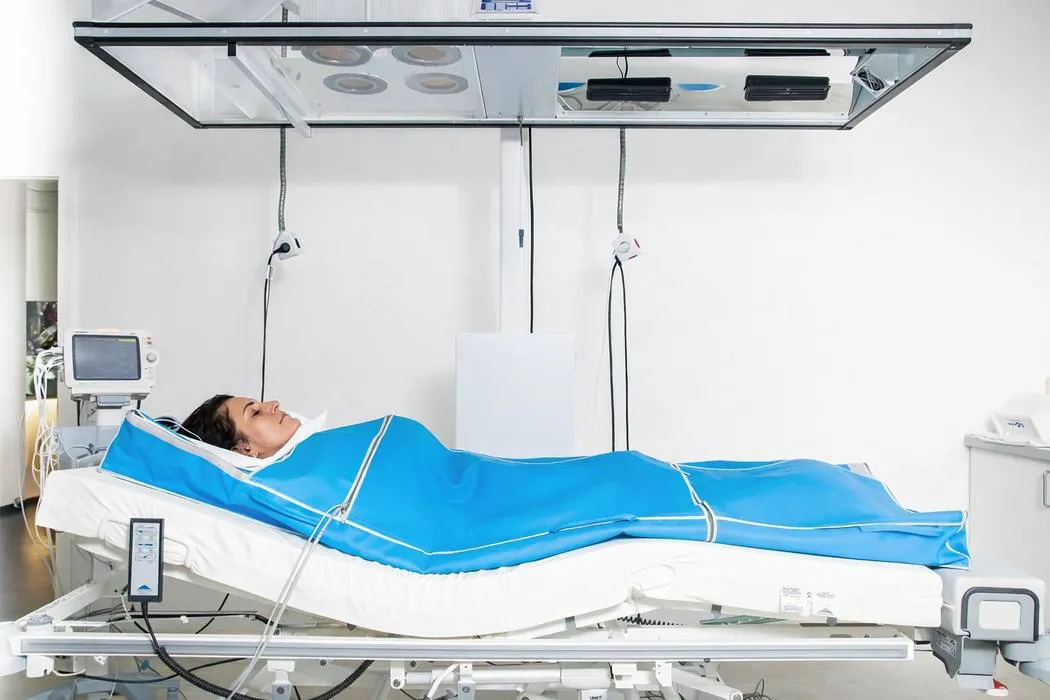
Heckel whole-body hyperthermia at our center is built by Heckel Medizintechnik, a German manufacturer that has specialized in whole-body hyperthermia systems since 1994. It uses water-filtered infrared-A (wIRA) radiation, a band of infrared energy that penetrates below the skin surface; the absorbed heat is carried through the whole body by the bloodstream, producing an even, systemic rise in core body temperature — a controlled, fever-like state. Every session is temperature-monitored throughout, and the treatment team adjusts intensity and duration to the individual patient.
The biological rationale — Borrelia's profound sensitivity to temperature — is the same as natural fever. The therapeutic delivery is different: controlled, monitored, and individually adjusted, rather than left to the body's own thermoregulation.
At the Lyme Re-code, Heckel hyperthermia is positioned within a coordinated treatment sequence. It is one tool inside an individualized protocol, not a standalone option, and it is added only after the immune system has been prepared — after the 12-day foundation, in which apheresis clears the inflammatory burden and autologous Treg therapy restores immune regulation. In the 18-Day Program, hyperthermia is layered onto that prepared immune system. Whether hyperthermia is appropriate, and at what intensity, is a medical determination made during the patient's evaluation.
The research does not tell us that hyperthermia alone cures chronic Lyme. But it establishes clearly that elevated temperature is biologically meaningful for Borrelia — not a placebo effect, not a non-specific intervention, but a direct engagement with one of the organism's most fundamental biological vulnerabilities.
Our clinical team evaluates each patient individually to determine whether Heckel hyperthermia is appropriate and how it fits within your treatment protocol.
Check My Eligibility